
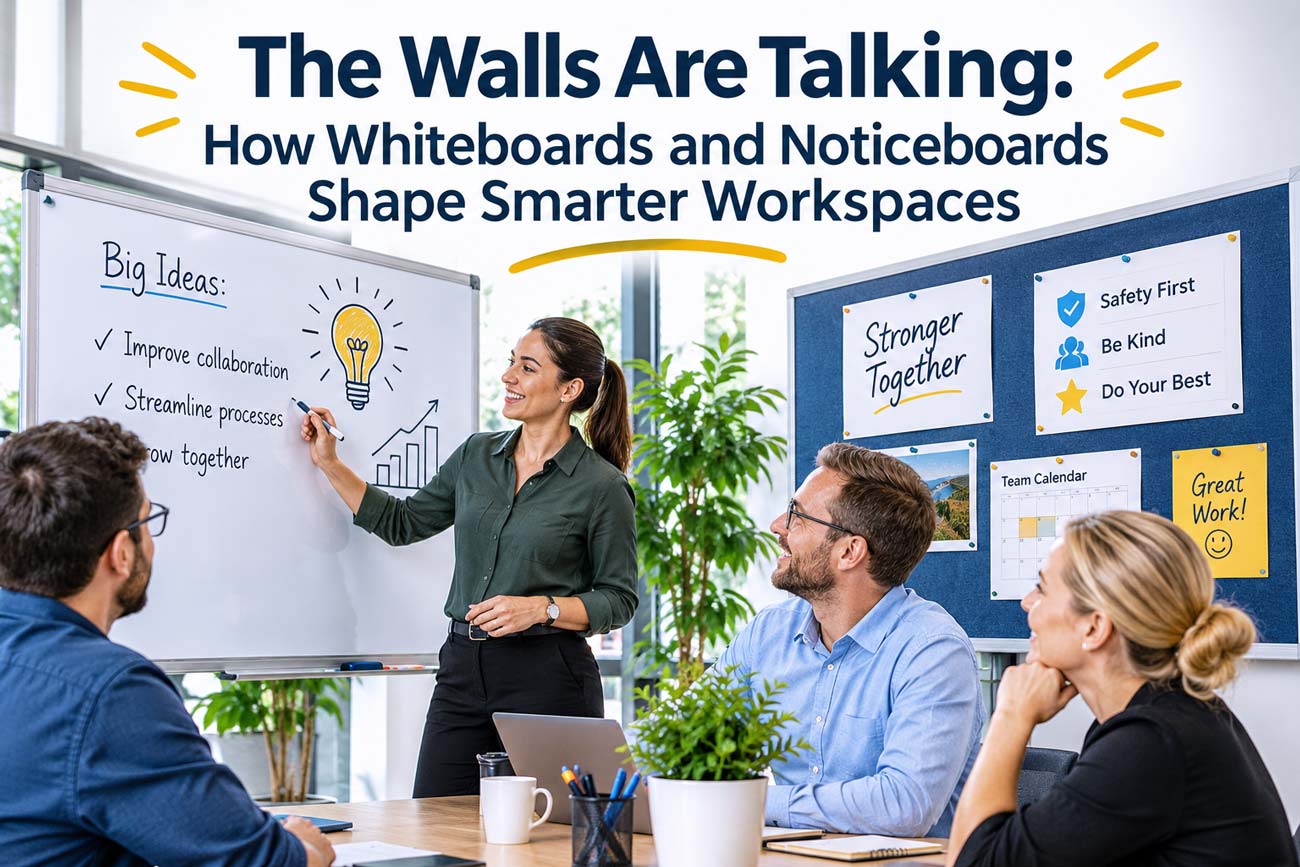
22 Oct The Walls Are Talking: How Whiteboards and Noticeboards Shape Smarter Workspaces
Beyond the Blank Wall: How Visual Communication Creates Smarter, More Productive Workspaces
Walk into a well-organised workplace, and you will often notice something that has very little to do with computers, software or expensive technology. Ideas are visible. Projects are clearly mapped out, important information is easy to find, and teams have somewhere to share their thinking. Whether it is a busy office, a school classroom, a manufacturing facility or a collaborative meeting space, whiteboards and noticeboards can quietly influence how effectively people communicate and work together.
In an increasingly digital world, the value of physical communication tools is sometimes overlooked. Yet a simple whiteboard can transform a conversation into a practical action plan, while a strategically positioned noticeboard can keep an entire team informed without another email or notification. Across New Zealand, businesses and educational facilities continue to use these versatile tools to encourage collaboration, improve organisation and create more engaging environments.
The real advantage is not simply having somewhere to write or display information. It is about making knowledge accessible, encouraging participation and turning ordinary walls into useful working spaces. With the right combination of whiteboards, noticeboards and flexible display solutions, even the simplest environment can become more organised, interactive and productive.
Why Are Whiteboards and Noticeboards Still Essential in Modern Workspaces?
How Does Visual Communication Improve Workplace Productivity?
Modern workplaces generate enormous amounts of information, but communicating that information effectively remains a challenge. Emails disappear into crowded inboxes, digital notifications compete for attention, and important updates can easily be overlooked. Visual communication offers a practical alternative by placing essential information somewhere people can see and understand it immediately.
A well-positioned whiteboard can display project deadlines, daily priorities, production targets or upcoming meetings. Instead of repeatedly searching through documents or asking colleagues for updates, employees can refer to a shared visual reference. This creates greater transparency and helps teams maintain a consistent understanding of what needs to happen next.
Visual communication can also simplify complex information. Flowcharts, diagrams, schedules and colour-coded notes allow people to recognise relationships between tasks without reading lengthy explanations. In workplaces where information changes frequently, the ability to update a board in seconds makes it particularly useful.
For businesses considering practical ways to improve their working environments, investing in quality whiteboards and noticeboards can provide a straightforward starting point. Their effectiveness comes from making communication visible, accessible and easy to maintain.
Why Do Physical Display Boards Encourage Better Collaboration?
Collaboration often begins when people have a shared space to explore ideas. A whiteboard provides an open surface where individuals can contribute suggestions, challenge assumptions and develop solutions together. Unlike a presentation controlled by one person, a physical board invites participation from everyone in the room.
During brainstorming sessions, team members can sketch concepts, draw connections and reorganise information as discussions progress. This encourages a more interactive approach to problem-solving and makes it easier to build upon another person’s contribution.
Noticeboards support collaboration differently. They create a central location for announcements, achievements, staff information and shared resources. In workplaces with multiple departments or rotating shifts, these displays can help maintain continuity between people who may rarely work together directly.
The physical presence of information also reinforces shared responsibility. When a project timeline or team objective is visible, everyone has a clearer understanding of current priorities. This does not replace digital communication, but it creates an additional layer of engagement that can be particularly valuable in busy, collaborative environments.
How Can Whiteboards Turn Ordinary Meetings into Productive Conversations?
Why Are Whiteboards Effective for Brainstorming and Problem-Solving?
Some of the most productive meetings begin with a blank surface and a question that needs answering. A whiteboard provides the freedom to explore possible solutions without committing immediately to a fixed structure or presentation.
Participants can draw diagrams, create lists, compare alternatives and identify connections between ideas. As the discussion develops, information can be moved, removed or expanded. This flexibility encourages experimentation and helps teams move beyond simply talking about problems towards actively working through them.
Whiteboards are especially useful when dealing with complex processes. A business reviewing its customer journey, for example, can map each stage visually and identify areas where communication or efficiency could improve. A construction team might use a similar approach to organise project stages, responsibilities and deadlines.
For larger meetings or workshops, mobile whiteboards provide additional flexibility. They can be positioned wherever participants need them, allowing smaller groups to work independently before bringing their ideas together.
The result is a meeting environment where discussions become visible, contributions are easier to follow, and decisions can be recorded as they happen.
How Can Visual Planning Help Teams Turn Ideas into Action?
Generating ideas is only the beginning. One of the biggest challenges in any workplace is converting discussion into practical steps that people understand and follow.
Whiteboards can help bridge this gap by creating a visible connection between planning and implementation. After a meeting, teams can organise agreed actions into categories such as priorities, responsibilities, deadlines and progress. This makes it easier to identify what has been decided and who is responsible for each task.
A simple visual planning system might divide a board into three sections: tasks to complete, work currently underway and completed activities. As projects progress, information moves between these areas, creating an immediate picture of overall progress.
This approach can be useful for marketing teams, construction businesses, manufacturers, educational organisations and service providers. It is particularly effective when several people contribute to the same project.
The most successful visual planning systems are usually simple enough to maintain consistently. A board that is regularly updated becomes a working resource rather than a collection of forgotten notes.
-
 This product has multiple variants. The options may be chosen on the product page
Staff Indicator Whiteboards
Price range: $235.00 through $280.00 Excl GST -

Week Schedule Planner Whiteboard
$440.00 Excl GST
What Makes Noticeboards Such Powerful Tools for Workplace Communication?
How Can Noticeboards Reduce Information Overload?
Workplace communication becomes less effective when important messages are buried beneath less relevant information. Staff may receive numerous emails, notifications and reminders throughout the day, making it difficult to distinguish essential updates from routine correspondence.
Noticeboards create a dedicated location for information that needs to remain accessible. Health and safety notices, staff announcements, operational procedures, upcoming events and important deadlines can be organised into clearly defined sections.
Unlike digital messages that require employees to open a device or application, a noticeboard presents information as part of the physical environment. People can review relevant updates while moving through shared spaces, taking breaks or preparing for their working day.
The effectiveness of a noticeboard depends heavily on how it is organised. Clear headings, readable text, consistent positioning and regular updates help prevent displays from becoming cluttered or outdated.
Businesses can also use different colours or sections to distinguish between departments, priorities or types of information. A thoughtfully maintained noticeboard becomes a reliable communication point that complements existing workplace systems.
Why Do Well-Designed Noticeboards Improve Workplace Organisation?
Organisation is not simply about storing information. It is about making the right information available to the right people at the right time.
Noticeboards provide a structured way to display material that employees, visitors or students need to access regularly. In offices, they might contain departmental schedules, meeting notices or internal announcements. In schools, they can display classroom information, student work and upcoming activities.
In manufacturing or industrial environments, noticeboards may be used to communicate operational instructions, safety reminders and maintenance schedules. Their placement can be particularly important in areas where employees do not have convenient access to computers.
The design of the board also influences its usefulness. Fabric surfaces provide flexibility for frequently changing notices, while enclosed or lockable designs can help protect important documents from accidental removal or interference.
For spaces requiring both written updates and pinned information, a combination whiteboard and noticeboard offers a practical way to bring different communication functions together.
When information is presented consistently and kept current, noticeboards help create more orderly, informed and professional environments.
How Are Whiteboards Changing the Way People Learn and Share Knowledge?
Why Is Visual Learning Important in Modern Classrooms?
Classrooms are environments where information must be communicated clearly to students with different learning preferences, abilities and levels of understanding. Visual teaching resources can help make complex subjects more approachable by presenting information through diagrams, illustrations, examples and written explanations.
Whiteboards allow teachers to demonstrate ideas progressively rather than presenting every detail at once. Mathematical problems can be solved step by step, scientific concepts can be illustrated, and language exercises can develop through direct student participation.
The ability to erase and revise information also encourages experimentation. Students can attempt answers, correct mistakes and explore alternative solutions without treating every contribution as permanent.
Interactive teaching activities become easier when learners can physically participate. Small groups might use whiteboards to organise research, solve problems or prepare presentations before sharing their findings with the wider class.
A suitable classroom whiteboard should provide a clear writing surface, adequate visibility and sufficient space for the intended activities. Durability is also important because educational boards frequently experience intensive daily use.
How Do Mobile Whiteboards Support Flexible Teaching Environments?
Modern educational spaces increasingly accommodate different teaching methods, including group activities, independent learning and collaborative projects. Fixed classroom layouts do not always provide the flexibility required for these approaches.
Mobile whiteboards allow teachers to bring a writing surface directly to the students who need it. Rather than requiring every activity to take place at the front of the classroom, educators can create smaller working areas where groups explore different topics simultaneously.
This can be particularly useful in shared learning spaces, libraries, training centres and classrooms where furniture arrangements change throughout the day.
Double-sided boards offer additional versatility by providing separate surfaces for different activities. One side might contain instructions or examples, while the other is used for student contributions.
The double-sided pivoting mobile whiteboard is an example of how adaptable equipment can support changing teaching requirements without permanent alterations to a room.
By allowing teaching resources to move with the activity, mobile whiteboards help educators make more effective use of available space.
-
 This product has multiple variants. The options may be chosen on the product page
Mobile Whiteboard Trolley
Price range: $448.00 through $1,059.00 Excl GST -
 This product has multiple variants. The options may be chosen on the product page
Mobile Whiteboard, Pivoting – Double Sided
Price range: $682.80 through $1,402.80 Excl GST
Can Better Workspace Design Improve Employee Focus and Efficiency?
How Does the Physical Environment Influence Everyday Productivity?
The design of a workplace affects how people move, communicate and concentrate. While lighting, furniture and acoustics receive considerable attention, the placement of visual communication tools can be equally important to daily operations.
A whiteboard positioned near a team workspace can support quick planning discussions without requiring employees to book a meeting room. A noticeboard near a shared entrance can communicate essential updates before staff begin their day.
These small design decisions can reduce unnecessary interruptions and make routine information easier to access.
However, placement matters. A board installed in an inconvenient location may receive little attention, while one positioned in a busy walkway could create distractions or congestion. The ideal location depends on the information being displayed and the people who need to use it.
Workspace design should also consider visibility, accessibility and the frequency of updates. Boards intended for daily planning need to be easy to reach, while displays containing longer-term information may be better suited to shared circulation areas.
Thoughtful positioning helps ensure that communication tools become part of normal workplace routines rather than decorative additions.
How Can Whiteboards Help Create More Focused Collaborative Spaces?
Open-plan offices provide opportunities for communication, but they can also make focused work difficult when several activities happen simultaneously.
Whiteboards can help define areas for different tasks. A dedicated brainstorming space, for example, gives teams somewhere to develop ideas without disrupting colleagues who need quieter working conditions.
Freestanding boards and mobile room dividers offer additional possibilities. They can create temporary boundaries between activities while providing useful surfaces for writing, planning or displaying information.
A mobile whiteboard room divider can serve both purposes, offering a double-sided writing area while helping separate smaller working groups.
This flexibility is particularly valuable in training rooms, shared offices and multipurpose facilities where permanent partitions would limit how the space can be used.
Rather than redesigning an entire workplace, organisations can use adaptable equipment to create different working environments as required. The ability to reconfigure a room quickly makes it easier to accommodate meetings, workshops, individual tasks and collaborative projects within the same space.

What Role Do Whiteboards Play in Business Planning and Project Management?
How Can Visual Management Improve Accountability?
Effective project management requires more than assigning tasks. Everyone involved needs to understand what is happening, what remains outstanding and how their responsibilities contribute to the overall objective.
Visual management uses clearly displayed information to make these relationships easier to understand. Whiteboards can present project stages, delivery schedules, operational targets and progress indicators in a format that teams can review together.
This approach can be particularly useful in environments where activities change throughout the day. Construction companies might display work schedules and site priorities, while manufacturing businesses could use boards to communicate production requirements or maintenance activities.
When information is visible, team members can identify potential delays and discuss solutions before minor issues develop into larger problems.
Accountability also becomes more straightforward when responsibilities and deadlines are clearly recorded. Rather than relying entirely on verbal instructions, teams have a shared reference that supports follow-through.
Visual management works best when information is accurate, relevant and regularly reviewed. A simple, consistently maintained system is generally more valuable than an elaborate display that nobody updates.
Why Are Planner Whiteboards Useful for Long-Term Organisation?
Not every workplace challenge requires an immediate solution. Many organisations need to coordinate activities across weeks, months or an entire year.
Planner whiteboards provide a reusable surface for organising these longer-term commitments. They can display staff rosters, maintenance schedules, training programmes, marketing campaigns, project milestones and upcoming events.
One of their greatest advantages is flexibility. Dates, responsibilities and priorities can be adjusted as circumstances change without producing new printed schedules.
For businesses managing multiple projects, a shared planning board can help identify overlapping deadlines and potential resource conflicts. Schools and training organisations can use similar systems to coordinate events, assessment periods and classroom activities.
A yearly planner whiteboard can be particularly useful when teams need a broad overview of future commitments rather than focusing only on individual tasks.
The key is to select a planning format that matches the organisation’s actual requirements. Daily operational schedules, monthly calendars and annual planning systems each serve different purposes, and the most suitable option depends on how frequently information changes.
How Can Whiteboards and Noticeboards Support Different Industries?
Why Do Commercial and Industrial Workplaces Need Durable Display Solutions?
Commercial and industrial environments often place greater demands on communication equipment than traditional offices. Boards may be used repeatedly throughout the day, exposed to busy working conditions or positioned in areas where multiple teams rely on the same information.
Durability becomes an important consideration when selecting suitable products. Strong framing, dependable mounting systems and writing surfaces designed for frequent use can help maintain performance over time.
Porcelain-on-steel whiteboards are particularly suitable for intensive use because their hard, non-porous surfaces resist staining and ghosting when maintained correctly. Magnetic functionality also allows printed schedules, charts and other resources to be displayed alongside handwritten information.
Industrial workplaces may require boards for shift planning, safety communication, production monitoring or operational coordination. In these settings, clarity and reliability are often more important than decorative appearance.
Businesses considering new display equipment should assess the conditions in which it will be used, the frequency of updates and the expected lifespan of the product.
Choosing equipment designed for the intended environment can reduce unnecessary replacement costs while supporting consistent communication.
How Do Display Boards Benefit Retail, Hospitality and Customer-Facing Environments?
Whiteboards and noticeboards are not limited to internal business communication. They can also help organisations present information to customers, visitors and members of the public.
Retail businesses may use display boards to highlight promotions, communicate opening information or direct customers towards particular areas. Hospitality venues can display event details, menus, announcements or temporary notices.
In reception areas, well-presented information helps visitors understand where to go and what services are available. Training facilities, community centres and event venues can use portable boards to communicate schedules or provide directions.
The appearance of these displays matters because they contribute to the overall impression of the business. Clear, organised and professionally presented information reinforces a sense of reliability and attention to detail.
A portable display board provides flexibility for organisations that regularly change their messaging or need to move displays between locations.
Choosing the right combination of size, surface material and positioning allows businesses to communicate effectively without relying entirely on electronic signage.
How Do You Choose the Right Whiteboard or Noticeboard for Your Space?
What Should Businesses Consider When Selecting Whiteboard Materials?
The writing surface is one of the most important factors when choosing a whiteboard because it affects durability, cleaning requirements and long-term performance.
Acrylic-on-steel surfaces can provide a practical solution for general office use, particularly where writing requirements are moderate. Porcelain-on-steel surfaces are generally better suited to environments where boards are used intensively and need to maintain a clean, reliable finish over many years.
Magnetic functionality adds another level of versatility. Documents, charts, diagrams and other resources can be attached directly to the board, allowing it to function as both a writing surface and a display area.
Size should also reflect the intended use. A compact board may be sufficient for individual planning, while training rooms and larger meeting spaces often benefit from wider surfaces that remain readable from a distance.
Mounting arrangements are another consideration. Wall-mounted boards provide a permanent communication point, while mobile designs offer greater flexibility.
Businesses should evaluate how often the board will be used, who will use it and whether its location is likely to change before selecting a particular model.
When Should You Choose a Custom-Made Whiteboard or Noticeboard?
Standard whiteboards and noticeboards meet many everyday requirements, but some environments benefit from equipment designed specifically for their dimensions, layout or operational needs.
Custom-made boards can help organisations make better use of unusual wall spaces, create larger planning areas or accommodate specialised communication requirements.
A business might require a particular board size to fit between existing fixtures, while a school could need a surface that supports a specific teaching activity. Other organisations may prefer a combination of writing and display areas within a single unit.
Customisation can also involve colours, framing, surface materials and presentation formats. These details can help communication equipment fit more naturally into an established interior design.
For organisations seeking equipment suited to their individual requirements, 3D Products offers New Zealand-made display solutions, including custom-sized whiteboards and noticeboards.
The most important consideration is functionality. A custom board should solve a genuine space or communication challenge rather than simply provide a different appearance.
-
 This product has multiple variants. The options may be chosen on the product page
Hinged Whiteboard
Price range: $345.00 through $423.00 Excl GST -
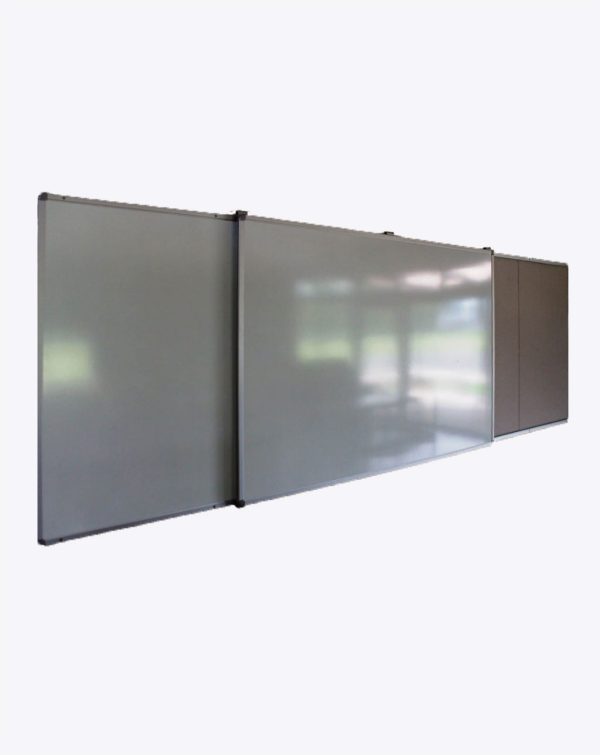
Sliding Whiteboards – Single, Double or Triple Sliders
Why Is Quality More Important Than Price When Buying Whiteboards in NZ?
How Does Long-Term Durability Affect the Value of a Whiteboard?
The initial purchase price is only one part of the overall cost of workplace equipment. A whiteboard that deteriorates quickly, becomes difficult to clean or requires frequent replacement may prove more expensive over time than a durable alternative.
Writing surface quality has a direct influence on usability. Lower-quality surfaces can become stained or develop persistent marker residue, particularly when exposed to frequent use or unsuitable cleaning products.
A durable surface that remains easy to write on and clean can maintain a professional appearance for longer. Strong framing and reliable mounting components also contribute to the overall lifespan of the board.
For schools, offices and commercial facilities, replacement costs may include more than the price of the product itself. Installation time, disruption and the disposal of worn equipment can all add to the expense.
Selecting a board according to its expected workload is therefore a practical investment decision. A lightly used office board and a heavily used classroom board may require different specifications, even when their dimensions are similar.
Why Should New Zealand Businesses Consider Locally Manufactured Display Products?
Locally manufactured products can offer practical advantages for organisations seeking reliable communication equipment, particularly when customisation, product knowledge and ongoing support are important.
New Zealand businesses and educational facilities often have specific requirements relating to room dimensions, building layouts and how equipment will be used. Working with a local manufacturer can make it easier to discuss these needs and identify suitable solutions.
3D Products has been manufacturing and supplying equipment for New Zealand organisations for decades, with experience across educational, commercial and industrial environments.
Its range includes whiteboards, noticeboards, mobile display systems, room dividers and specialised products designed for different applications.
Local manufacturing also creates opportunities to request particular dimensions or configurations rather than relying exclusively on standard imported sizes.
For organisations purchasing equipment intended to remain in service for many years, product quality, suitability and the ability to obtain informed advice should carry significant weight in the decision-making process.
The Future of Smarter Workspaces Starts with Better Communication
Why Will Physical Communication Tools Remain Relevant in a Digital World?
Digital technology has transformed how organisations communicate, but it has not eliminated the need for shared physical spaces where people can think, plan and collaborate.
Whiteboards and noticeboards offer something fundamentally different from digital platforms. They make information visible without requiring people to open an application, navigate a menu or search through stored files.
Their simplicity is part of their strength. A marker, a clear surface and a group of people can be enough to begin solving a problem, organising a project or explaining an idea.
As workplaces continue to evolve, flexibility will remain important. Mobile whiteboards, adaptable display systems and multifunctional room dividers allow organisations to create spaces that support different activities throughout the day.
The most effective environments are unlikely to rely entirely on either physical or digital communication. Instead, they will combine both approaches, using each where it provides the greatest practical value.
A well-designed whiteboard or noticeboard remains a simple but useful tool for bringing people, information and ideas together.
How Can 3D Products Help Create a More Organised and Productive Environment?
Creating a smarter workspace does not always require major renovations, expensive technology or complicated new systems. Sometimes the most effective improvements come from making existing spaces easier to use.
The right whiteboard can encourage collaboration, simplify planning and provide a central location for developing ideas. A well-organised noticeboard can improve communication, keep important information accessible and help people stay informed.
For organisations that need adaptable working environments, mobile boards and room dividers provide additional flexibility without permanent structural changes.
3D Products supplies a wide range of New Zealand-made whiteboards, noticeboards and display solutions for schools, offices, commercial facilities and other professional environments. With options covering different sizes, surfaces, colours and configurations, businesses can select equipment that suits their specific requirements.
Whether you are upgrading a meeting room, improving classroom resources or creating a more efficient workplace, explore the range at 3D Products or contact the team to discuss suitable display solutions.
A smarter workspace begins when people can see what matters, share their ideas and turn information into action.